By Buddy Rathmell, Founder of Map Winners · 9 min read

Technical SEO audit services can run you less than $200 or close to $5,000 for the exact same size website, and that gap is not a typo. A business broker and a tree care company might request the same crawl of the same number of pages and get quotes that are twenty times apart. The split usually has nothing to do with how good the provider is. It comes down to what they actually check, how deep they go, and whether they hand you a to-do list or just a pile of data.
A cheap audit might scan your site with a tool like Screaming Frog and send you a spreadsheet of broken links. A pricier one might dig into Core Web Vitals, JavaScript rendering, schema markup, and indexation issues, then write out exactly what to fix and in what order. Both get called a technical SEO audit. If you are a broker or local business owner collecting quotes right now, you need to know what sits inside each price tag before you pick one, not after you have already paid for it.
Table of Contents
What A Technical SEO Audit Actually Covers
A real audit checks whether search engines can crawl your site, whether your pages actually get indexed, how fast your pages load under Google's Core Web Vitals, how well your content renders if it's built with JavaScript, and whether your structured data (schema) is set up correctly so Google and AI tools can read it. Miss any one of these and you can have great content sitting on pages that never show up in the Local 3-Pack.
EZ Rankings, one of the firms that publishes its audit framework, groups the work into four buckets: Technical Audit, Competitive Audit, Content Audit, and UX & Conversion Audit. Only the first bucket covers the crawlability and Core Web Vitals items above, so a quote that only lists "technical" may skip content and conversion checks entirely.
| Audit scope | Typical price range | Typical turnaround |
|---|
| Basic technical crawl only | $100 to $500 | A few days |
| Full technical + content audit | $500 to $2,500 | 1 to 4 weeks |
| Enterprise or multi-site audit | $2,500 to $5,000+ | Several weeks |
Site size and complexity drive both price and timeline, as outlined in this breakdown of 2026 technical SEO audit costs. A ten-page broker website and a 500-location franchise site are not getting the same turnaround time, no matter who writes the quote.
When you start collecting quotes for seo technical audit services, you will run into four kinds of providers, and each one serves a different kind of client. Freelancers sit at the bottom of the price range, usually $100 to $500, and they work fine for a single-location site but rarely have the staff to handle a franchise network or a brokerage with dozens of listing pages. Boutique agencies charge $500 to $2,500 and give you more hands-on attention, per EZ Rankings' 2026 pricing data.
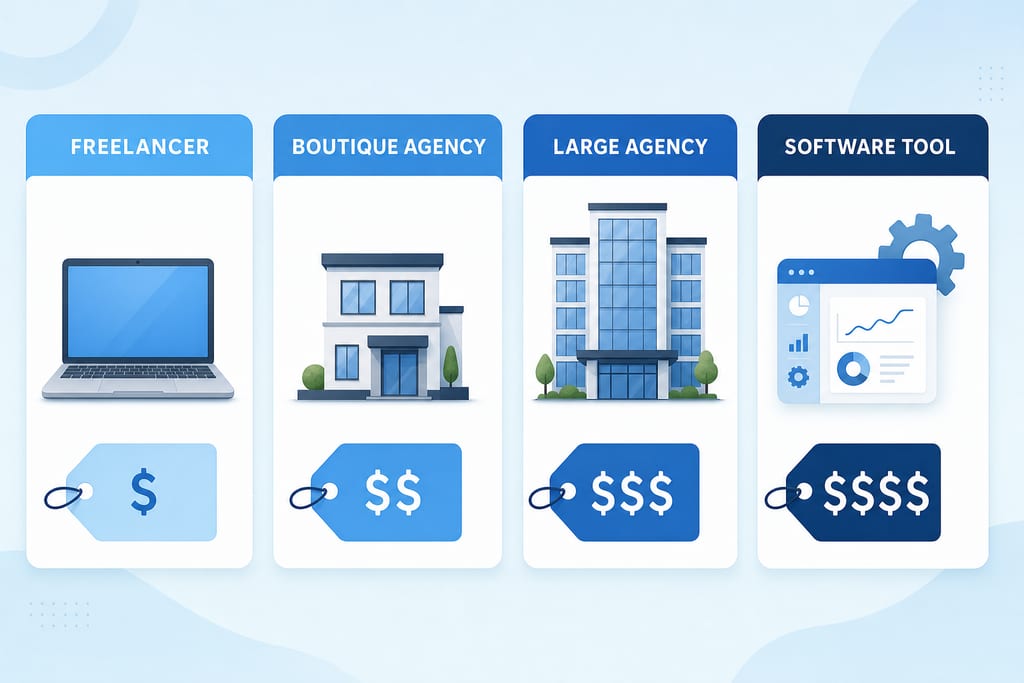
Large agencies like SeoProfy price their work from $750 to $2,500, with custom quotes once your site gets big enough. Software-only tools skip the human review entirely: Ahrefs starts at $99 a month, SEMrush at $119.95, Moz at $99, and Lumar at $500 a month for enterprise-size crawls. None of the software tools write you a fix list, they just flag problems and leave the prioritizing to you.
| Provider type | Price range | Best fit |
|---|
| Freelancer | $100 to $500 | Single-location site |
| Boutique agency | $500 to $2,500 | Local business, limited pages |
| Large agency | $750 to $2,500+ | Multi-location or complex site |
| Software tool | $99 to $500/month | In-house teams wanting raw data |
What You Get At Each Price Point
The dollar figure tells you almost nothing about what lands in your inbox. Clutch data shows technical audits running $100 to $5,000, on-page audits $375 to $2,500, and backlink audits $399 to $1,399, and most of the spread comes down to whether implementation is included or not. A low-tier quote usually means a raw crawl report, a spreadsheet of broken links and missing tags with no order of operations attached.
Higher tiers, like the one Internetzone I describes, pair a sitewide crawl with a developer-ready sprint backlog, QA checks, and before-and-after impact measurement. If your quote does not say who fixes what and in what order, you are buying data, not a plan. This pricing breakdown of what to expect from a technical SEO audit lays out similar ranges for 2026 buyers.
- Raw crawl report, no prioritization, often a one-time PDF
- Crawl report plus a ranked fix list, still a one-time deliverable
- Fix list plus implementation support from the provider's own team
- Full package with ongoing dashboards and before-and-after measurement
Red Flags To Check Before You Sign A Contract
The biggest risk is not overpaying, it is paying for a report nobody acts on. Internetzone I's own selection criteria cover audit depth and accuracy, actionability, scalability, local and national reach, implementation support, and reporting quality, and those same six points work as a vetting checklist for any quote you get.
Ask directly whether the price covers implementation or only the findings, since that single line determines whether you need a developer afterward. Confirm turnaround time in writing too, since full audits can take 25 to 40 days depending on site size and complexity. Request a sample report before you pay anything, so you can see if the last client got a fix list or just a pile of flagged URLs.
- Does the quote name who implements the fixes, you or them
- What is the written turnaround date, not just "a few weeks"
- Can they show a sample report from a site your size
- Does reporting stop after delivery or continue on a schedule
- Do they check local listing consistency if you run multiple locations
Matching Scope To Your Business Size
A single-location home service site does not need the same scope as a 540-location operation. A tree care company with one address can get by with a basic crawl and a $99 to $119 monthly tool, while a franchise network or a crypto ATM operator running hundreds of listings needs an audit built for scale, not a tool meant for one domain.
Business brokers carry an extra wrinkle: directory listings and brokerage profiles need entity consistency checks alongside the standard crawl, since a mismatched name or address across a dozen listings confuses both Google and AI tools. Buying enterprise-tier software for a one-location site wastes money every month, not just once. Map Winners treats technical work as one piece of a full local SEO and AI search visibility package rather than a standalone audit product.
- Single location: narrow crawl, monthly software tool is often enough
- Small multi-location: boutique agency audit with local listing checks
- Franchise or broker network: full crawl plus entity consistency review
- 540-plus locations: enterprise-tier provider with ongoing dashboards
Cheap Report Or Fixed Problem, Pick One
A $200 crawl report that sits in your inbox unread costs more than a $1,500 audit that actually gets acted on, because the ranking problems it found keep costing you calls every week it goes unfixed. The price tag on the audit is not the real cost. The real cost is the gap between the day a problem gets flagged and the day someone fixes it.
Software tools make that gap worse for a lot of buyers. Ahrefs, SEMrush, and Moz all run under $120 a month, but none of them tell you which fix matters first or write the code to patch it. Someone on your team has to read the output, understand Core Web Vitals and schema well enough to prioritize, and then either fix it themselves or hand it to a developer. For a one-location tree care company that might work fine. For a brokerage juggling a dozen listing pages, it usually means the report gets skimmed once and forgotten.
Agencies that bundle the audit with implementation close that gap directly, since the same team that finds the broken schema or the slow-loading page also fixes it, often with QA built in. That matters most for multi-location brands, where a single freelancer cannot realistically manage hundreds of pages the way technical SEO work for a franchise network demands.
| Option | Who it fits | What it costs you |
|---|
| Cheap crawl report only | Single-location site with in-house help | Your time to interpret and fix |
| Mid-tier audit, no implementation | Local business with a developer on call | A second invoice to fix what's found |
| Audit bundled with implementation | Multi-location or franchise brand | Higher upfront price, shorter gap to fixed |
Scalability is the real test for brokers and multi-location owners comparing quotes, since a provider's audit scope only matters if they can also execute it across every location you run, not just the one they used for the sample report.
Get A Quote Scoped To Your Business, Not A Generic Crawl
Before you compare a single dollar figure, send each provider your site size, your location count, and whether you're a broker juggling listing pages or a one-address home service shop. A price with no scope attached is a guess, not a quote. Ask them to put the implementation plan and reporting schedule in writing, in the same document as the price, so you know if you're buying a fix list or a one-time PDF. Map Winners builds technical fixes into its local SEO and GEO work rather than selling an audit on its own, so businesses that want problems fixed, not just flagged in a spreadsheet, get both in one scope. Pick the provider whose answer matches your size, not the lowest number on the page.
Common questions
Yes, Screaming Frog's free version crawls up to 500 URLs, which covers most single-location sites and listing pages. It will flag broken links and missing tags, but it will not prioritize fixes or check schema the way a paid audit does. For a brokerage with a handful of pages, it is a fine first pass before you call anyone.
What happens if the audit finds problems the provider can't fix themselves?
Ask that question before you sign anything, since some audits stop at the findings and hand you back to your own developer. Map Winners builds technical fixes into its local SEO and GEO work, so problems the crawl turns up get fixed by the same team that found them, not passed off to a separate contractor.
Should a multi-location business pay per location or one flat audit fee?
Most agencies quote a flat fee scaled to total page count and location count, not a per-location line item, though a few enterprise providers do bill per site for very large networks. Ask for the location count written into the quote itself, since a crawl of 10 pages and a crawl of 540 listing pages should never carry the same price.
How do I know if a quoted price actually includes a prioritized fix list?
Ask to see a sample report before you pay, and check whether it ranks issues in order of impact or just lists everything flagged by the crawl. A price alone never tells you this, two providers can quote the same number and one hands you a spreadsheet while the other hands you a step-by-step plan.