By Buddy Rathmell, Founder of Map Winners · 9 min read
Good review management can move your business up the Google Maps results faster than almost anything else you touch, because Google looks hard at how many reviews you have, how recent they are, and how often you respond. A listing with five reviews from last year loses to a competitor with forty reviews and a reply on every one, even if the five-review business does better work. For a business broker or a home services company, that is the difference between showing up when someone searches near them and getting skipped entirely.
Most businesses do not lose customers because of one bad review. They lose them because a bad review sat there for three weeks with no response, and the next person who read it assumed nobody was home. A short, honest reply posted the same day often does more for trust than the review itself ever took away. That only works if someone is watching for new reviews and answering them on a schedule, which is why this has to run as a system, not a once-a-year cleanup before a slow month.
Table of Contents
What Counts as Real Review Management
Asking happy customers for a review is one piece of a bigger job. Real review management breaks into four separate tasks, and skipping any one of them leaves gaps a competitor can walk through.
| Task | What it involves | Manual approach | Automated approach |
|---|
| Generation | Asking customers to leave a review | Staff remembers to ask, sometimes | Text or email sent right after the job |
| Monitoring | Catching new reviews as they post | Owner checks once a week or less | Alert fires within minutes |
| Responding | Replying to good and bad reviews | Replies happen when there's time | Draft ready, same day every time |
| Reporting | Tracking rating trends over time | No record, hard to spot patterns | Monthly numbers on volume, rating, response time |
The manual column works fine until a business gets busy, then it quietly stops. An automated review management strategy keeps the asking and the replying running even when staff are slammed with jobs.
There's a newer reason this matters. AI assistants like ChatGPT and Gemini read review sentiment, not just star counts, before they recommend a business to someone asking for a broker or a contractor nearby. A pile of recent, well-answered reviews signals a business that's active and trusted, which is the same signal those tools look for.
Getting More Reviews Without Sounding Pushy
The best time to ask for a review is right after the job is done, not three weeks later in a bulk email nobody remembers opening. A tree care crew that sends a text the same afternoon they finish a removal will beat a monthly email blast almost every time, because the customer still has the job fresh in their head.
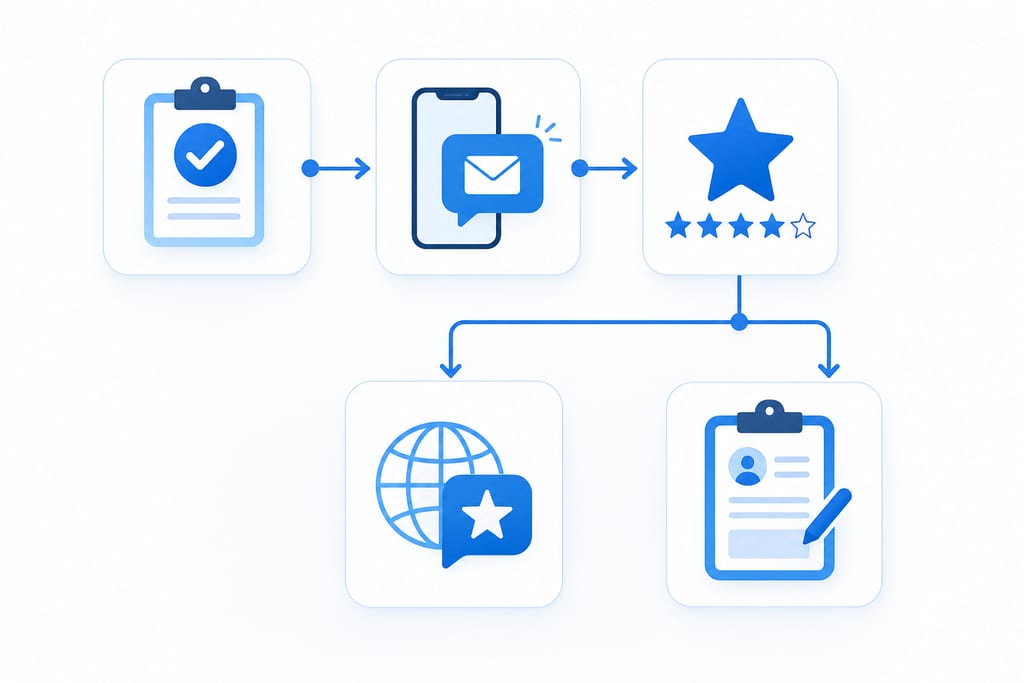
Text requests get opened faster than email for home services and tree care, often within minutes instead of days. A QR code on the invoice or the truck works the same way, it turns a five-second scan into a review before the customer drives off. Business brokers have a different timing rule: ask the seller for a review only after the deal has closed, never while terms are still being worked out.
- Text sent within one hour of job completion
- QR code printed on the invoice or receipt
- Email follow-up for customers who did not respond to the text
- Broker review request triggered by the closing date, not the listing date
A system like this, described in detail in the review system that builds trust, keeps the ask consistent instead of depending on someone remembering to send it.
Catching Bad Reviews Before They Spread
A one or two star review left unanswered for even a few days starts shaping what the next ten people think. Real-time alerts across Google, Facebook, and Yelp catch that review within minutes, which beats a weekly manual check by a wide margin.
A fast, calm public reply often matters more to future readers than the bad review itself. People searching for a broker or a contractor read how an owner handled the complaint, not just what the complaint said. A private follow-up message to the reviewer can sometimes get an unfair or mistaken review updated or pulled, something that rarely happens once the review has been sitting public for a month.
- Set alerts on Google, Facebook, and Yelp, not Google alone
- Reply publicly within the same day, not the same week
- Follow up privately before asking for a review to be changed
- Log every one and two star review so patterns show up over time
The research backs the timing part up directly, a study on reputation management's effect on small business performance found response speed tied closely to repeat customer rates. Minutes matter more than most owners assume.
Writing Responses That Build Trust Fast
A copy-paste reply like "Thanks for your feedback" reads as fake the second a customer sees the same line under five other reviews. Readers and AI tools both notice when a response actually names the job, the service, or the location, because that is the kind of detail a real person writes.
Naming the service and city inside a reply, such as "glad the oak removal in Roanoke went smooth," does double duty. It reads human to the next customer, and it feeds the same entity signals that AI search visibility work depends on. Responding to every review, good and bad, correlates with stronger Map Pack placement, not just avoiding damage from the bad ones.
- Name the specific service or job in the reply
- Mention the city or neighborhood when it fits naturally
- Thank the reviewer by first name where Google allows it
- Reply to five-star reviews too, not only the complaints
Every reply is a small piece of content Google and AI assistants both read, so skipping the good reviews leaves half the signal on the table.
What Review Management Actually Costs
Software-only tools for review management typically run $50 to $300 a month, and that number buys the alerts and the dashboard, not the writing. Someone still has to read each review and draft a reply that does not sound robotic, which is the part most owners underestimate when they sign up for a tool alone.
Full-service agency management usually bundles review work together with Google Business Profile upkeep and local SEO, since the three feed the same ranking signals anyway. Map Winners folds review and reputation management into its local SEO packages rather than selling it as a standalone add-on, so the review activity and the ranking work move on the same schedule.
| Option | Typical cost | What's included |
|---|
| DIY | $0 cash, hours of time | Manual asks, manual replies |
| Software-only | $50 to $300 a month | Alerts and request automation, no writing |
| Full-service agency | Bundled with SEO package | Asks, monitoring, replies, reporting |
The right choice usually comes down to whether the owner has staff hours to spare each week, since that is what DIY actually costs even at zero cash outlay.
Single Location, Multi-Location, or Franchise Rollout
A single-location broker or home services business can run review management on one calendar, one voice, one owner checking replies. A multi-location brand running ten, fifty, or hundreds of sites has a different problem: one location replying fast and warm while another goes quiet for two weeks sends AI assistants a mixed signal about the whole brand, not just that one site. ChatGPT and Perplexity read sentiment across locations when a searcher asks for the nearest branch, so one neglected profile can drag down how the whole chain gets recommended.
The dentist case shows what happens when review work and profile work run together instead of separately. That practice moved from the 20th spot to the top 3 and was fully booked in about 60 days, not because of generation alone, but because replies, categories, and photos were all pulling the same direction at the same time.
Multi-location brands need the same fix at scale: a shared response template library so a reply in one city matches the tone of a reply in another, with local details swapped in, not a different voice entirely.
| Setup | What decides the choice | Main cost |
|---|
| Single location | One owner, one schedule | Owner's weekly hours |
| Multi-location brand | Shared templates across sites | Coordination time |
| Franchise network | Local manager variance | Oversight and audits |
A franchise network adds one more layer: local managers vary in how often they check reviews, so someone above the location level has to audit response time across sites, not just trust each manager to keep pace. That audit step is the part owners of a single shop never have to think about, and it is the part that breaks first when a brand scales without planning for it. The Google Business Profile optimization work has to move on the same schedule as the review replies, or the two signals start pulling apart.
Check Your Response Time This Week
Pull up your last ten reviews right now and see how many got a reply within 24 hours. If most sat for days, that's your answer. A broker or a home services owner with a few hours a week to spare can run generation and replies in-house with a basic tool. An owner already buried in jobs, closings, or calls cannot add review watching to that list without something slipping. That's the real choice, not software versus no software. If staff time is already spoken for, call Map Winners at 540-467-4751 and have them set up a managed system that asks, watches, and replies on a schedule, so the next slow month doesn't start with a stack of unanswered reviews.
Review Management Questions Owners Still Ask
Can I remove a review that names the wrong business or location by mistake?
You cannot delete it yourself, but you can flag it to Google as posted in error, and Google does pull wrong-location reviews once it confirms the mix-up. The faster fix is a public reply asking the reviewer to check the business name, since that often gets them to edit or delete it on their own within a day or two.
Will asking every customer for a review eventually look suspicious to Google?
No, asking every customer is normal and Google expects it from active businesses. What draws scrutiny is a sudden spike of ten reviews in one day after months of nothing, or reviews that all read like the same person wrote them. A steady trickle tied to real jobs, spread out over weeks, never raises a flag.
What happens to my review history if I switch review management companies?
Your reviews stay exactly where they are, since they live on your Google Business Profile, not inside any agency's software. What you lose is the response templates, alert settings, and reporting history built up with the old provider. Map Winners sets up new clients by auditing that existing review history first, so nothing from before the switch gets ignored or answered twice.
Do negative reviews ever actually help a business look more trustworthy?
A small number of negative reviews, each answered calmly and specifically, can make a profile look more real than one with nothing but five stars. Readers get suspicious of a perfect record, since it looks curated rather than earned. One or two honest complaints with a solid reply often build more trust than they cost.