By Buddy Rathmell, Founder of Map Winners · 8 min read

Google Maps optimization matters because only three businesses show up in the map pack when someone searches for a broker, a plumber, or a tree service near them, and everyone else gets buried below the fold. That gap is not random luck. Google is weighing your profile data, your reviews, your citations across the web, and signals from your website all at once, and ranking the three it trusts most. Most businesses never touch most of those pieces, so they stay stuck on page two while a competitor with a thinner service list sits at the top.
Fixing this is not complicated, but it does take fixing the right things in the right order. Your Google Business Profile needs the right categories, current photos, and a steady flow of reviews. Your business name, address, and phone number need to match everywhere they appear online. Your website needs pages built around the neighborhoods and services you actually want calls for. When those pieces line up, the calls and quote requests start coming without spending a dollar on ads.
Table of Contents
The Ranking Factors Google Actually Uses
Google has said for years that three things decide map pack order: relevance, distance, and prominence. Relevance is whether your profile and website match what the searcher typed. Distance is how close your listed address sits to the searcher or the area they searched.
Prominence is the broadest category, and it covers your review count and star rating, your citations across directories, and how often other sites and pages mention your business. A broker with 40 reviews and consistent listings on legal and finance directories usually outranks one with five reviews and a profile that only lives on Google.
| Factor | What Google checks | Where businesses lose points |
|---|
| Relevance | Category match, service keywords, profile completeness | Wrong or missing categories |
| Distance | Address proximity to the searcher | Listed address not central to service area |
| Prominence | Reviews, citations, website authority | Low review volume, inconsistent citations |
In practice, most businesses lose points in two spots: review volume and incomplete profile fields like services, attributes, or business hours. Both are things you can fix without redoing your whole site, and the full breakdown of how the Local 3-Pack decides who ranks goes deeper into how Google weighs each one.
Build a Profile Google Trusts From Day One
Your Google Business Profile is the single biggest lever you control, and the primary category you pick matters more than almost anything else on the page. Choose "Business Broker" over a vague label like "Consultant" and Google immediately understands who should see you. The guide to choosing Google Business Profile categories walks through how to pick the right one for your exact service.
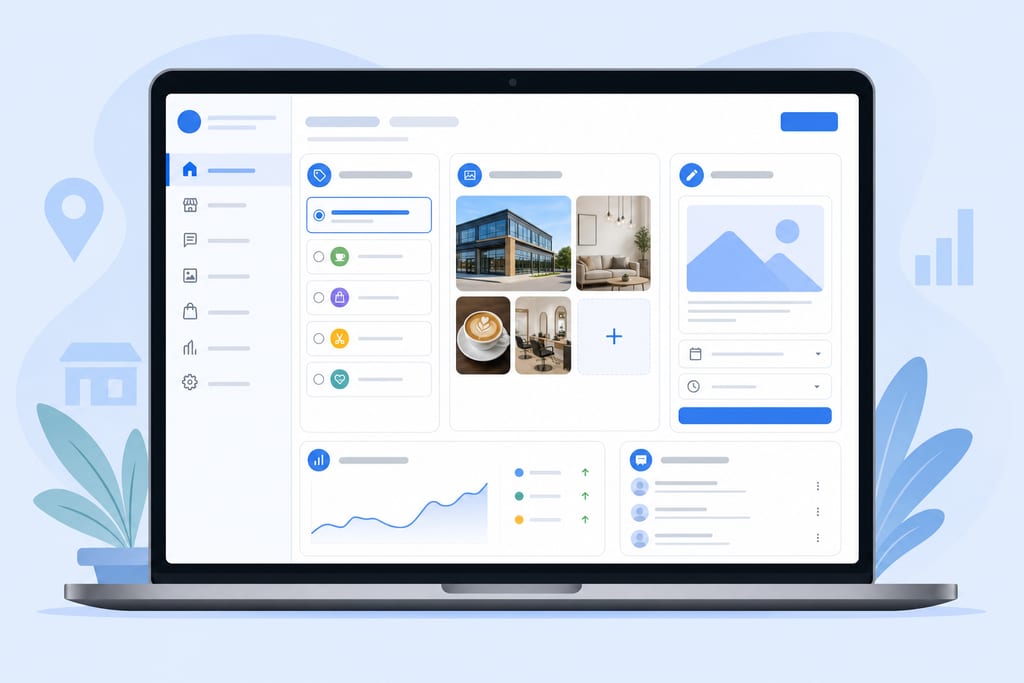
A profile with weekly photos and posts tells Google the business is active, not abandoned. Profiles updated at least once a week outperform static ones in almost every case we have tracked. If your listing has ever been suspended, that has to be resolved before anything else, since Google will not rank a profile it cannot verify.
- Set the primary category to match the exact service you want calls for
- Upload at least two new photos every week
- Post an update or offer weekly, not monthly
- Fill in every field: hours, services, attributes, service area
- Check suspension status before touching anything else
Turn Reviews Into a Ranking Advantage
Review velocity, the pace of new reviews coming in, matters more than your total once you pass a baseline of around 10 to 15. A broker with five reviews this month and two last month reads as active. A broker with 200 reviews and none in the last six months reads as stalled.
Responding to every review, the good ones and the bad ones, signals active management to both Google and the person reading your listing. Businesses that respond to reviews within 24 hours tend to hold higher map pack positions than those that let them sit. Automated text or email requests sent right after a job finishes raise response rates because the customer is still thinking about the work.
- Request a review the same day the job wraps up, not weeks later
- Respond to every review within a day
- Use a short automated text or email trigger tied to job completion
- Track monthly review count, not just lifetime total
Our review management work focuses on exactly this kind of velocity and response discipline.
Get Your Business Listed the Same Way Everywhere
Citations are mentions of your business name, address, and phone number on other sites, and when those details do not match, Google gets confused about which listing is actually correct. A broker listed as "ABC Business Brokers LLC" on one directory and "ABC Brokers" on another is splitting trust between two versions of itself. Every citation needs to use the exact same name, address, and phone number, down to the suite number.
Multi-city firms also need a dedicated page for each service area, not one page trying to rank for five cities at once. Hyperlocal content, like a page built around a specific neighborhood or county, adds the relevance signal Google looks for. The post on how to build location pages that rank covers the structure that works.
- Pull your current NAP from Google, Yelp, and two industry directories and compare them
- Fix any mismatch at the source, not just on your own site
- Build one page per city or service area you want to rank in
- Add neighborhood names and landmarks into that page's content
Manage Rankings Across Dozens of Locations at Once
A single-location business can manage its profile by hand. A brand with 20, 100, or more locations cannot, because each profile needs its own categories, photos, and local reviews rather than a copy-pasted template. Treating every location the same way is how multi-location brands lose rankings in their best markets while nobody notices for months.
Bulk tracking tools catch suspensions, review drops, and ranking slips across hundreds of profiles at once instead of relying on someone checking each one manually. One Map Winners client runs 540 Google Business Profiles, and that volume only works with centralized reporting, not spot-checks. A crypto ATM operator with locations spread across the country kept consistent visibility by using that same centralized system rather than managing each listing in isolation.
- Audit every location's category and hours on a set schedule, not ad hoc
- Flag suspensions and ranking drops through one dashboard
- Assign local photos and reviews per location, not a shared set
- Report performance by region so patterns show up fast
Who Should Handle This Alone, and Who Should Not
A single-location broker or home service owner with a few hours a week can handle the basics: posting weekly updates, requesting reviews after each job, fixing a mismatched phone number on one directory. That workload is small enough to fit between client calls, and nothing about it requires special tools or training.
The math changes once you add a second location, a suspended profile, or a franchise with separate teams in each market. Fixing one suspension can eat a full week of back-and-forth with Google support, and that is before you touch categories or photos. Running the same checklist across 20 or more profiles by hand means something slips, usually in your best market, and nobody notices until calls drop.
| Situation | Time needed per week | Realistic owner-managed outcome |
|---|
| One location, no suspension | 2 to 4 hours | Steady, manageable |
| One location, active suspension | 10+ hours for weeks | Often stalls without support |
| 5 to 20 locations | 15+ hours | Inconsistent, gaps appear |
| 50+ locations | Not realistic by hand | Requires centralized tracking |
Whichever side you land on, the work does not stop once rankings hit the top three. Google reweighs relevance, distance, and prominence continuously, so a profile left untouched for a few months drifts back down even after a strong start. Treating this as a one-time setup, instead of something checked weekly, is the most common reason brokers and multi-location brands lose a ranking they had already won. Local SEO service that includes ongoing maintenance, not just a launch, is what keeps a top-three spot from sliding back to page two.
Decide If You Fix It Yourself or Call for Backup
Pull up your own profile right now and check it against what you just read: categories, photo frequency, review velocity, matching NAP, and whether every location has its own local signals instead of a shared template. If one location feels manageable, start there with a few hours a week. If you spot gaps across several markets, a suspended listing, or a franchise where nobody owns this full time, that's a bigger lift than a part-time task list. Map Winners takes on that work with a 200% ROI guarantee and keeps going until the rankings land, which matters most for brokers and multi-location brands trying to run this across dozens of markets at once.
Google Maps Ranking Questions
How long does it take to see movement in the map pack after making changes?
Most brokers and local businesses see some movement within four to eight weeks, especially if the fix was a wrong category or a suspended listing. Full top-three positioning usually takes longer, often two to three months, since Google needs a track record of reviews and consistent activity before it trusts a profile enough to move it up.
Will optimizing my Google Business Profile hurt my current rankings during the process?
A short dip is possible right after you change your primary category or edit your business name, since Google re-evaluates the listing from scratch. This usually lasts a few days to a week, not months. Avoid changing several major fields at once, like category and name and address, in the same week, since that stacks the reset instead of spreading it out.
What happens if a competitor files a fake complaint against my listing?
Google reviews flagged complaints before taking action, and most fake reports from competitors get dismissed once you submit proof like a utility bill or lease for your listed address. The real risk is a slow response, since an unaddressed complaint can sit for weeks and trigger a suspension. Map Winners handles suspension recovery as part of its profile management work, including gathering the documentation Google asks for.
Can a home service business with no storefront still rank in the 3-Pack?
Yes, service-area businesses rank in the map pack the same way storefront businesses do, as long as the listed address is set up correctly and the service area is defined with real cities or counties, not a vague radius. Tree care companies, plumbers, and similar businesses that work from a home base or a shop with no walk-in traffic rank this way every day.